 |
| BC Archives i-689259-141 |
Tuesday, July 31, 2018
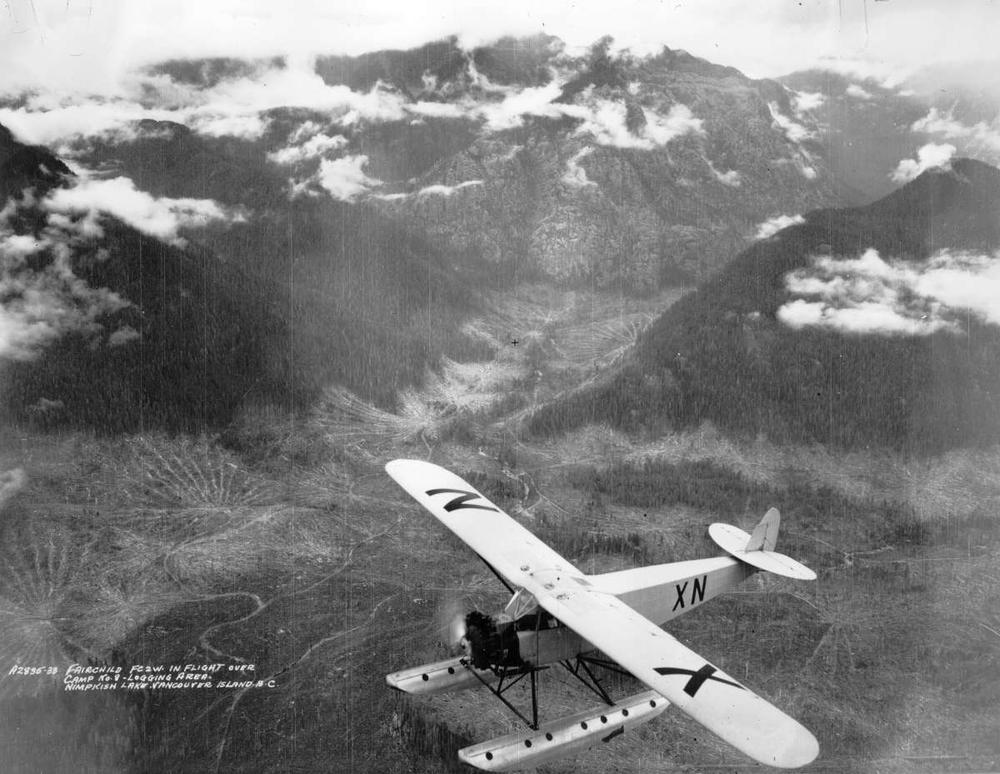
Air photos of early logging in the Nimpkish Valley
The North Island historical photograph of the week shows a Fairchild FC2W aircraft in flight over Camp No. 8 in the south end of the Nimpkish Lake area in 1934. The photo shows a radial style of logging radiating out along the valley. The FC2W was a single engine airplane designed for aerial surveys.

Hansen Lagoon
In the late 1800s and early 1900s settlers at Cape Scott tried to tame the wild landscape to cultivate crops and graze cattle. Rather than clearing the dense old growth forest, some settlers build massive dykes along the Fisherman River and Hansen Lagoon (1905). These dykes stopped the sea from inundating a swampy area and took advantage of rich organic soils. Unfortunately a promised railway to Cape Scott never materialized, and farmers found it difficult to sell their crops, beef and milk due to transportation challenges. The dykes also required constant upkeep to hold back the sea, and although the road and dyke system can still be seen at Cape Scott, it has largely reverted back to a grassy wilderness.
 |
| BC Archives a-09985_141 |
Friday, June 15, 2018
Building a road in Quatsino - 1909
For thousands of years the predominant method of transportation around the North Island was by water. When the first European settlers arrived they wanted to transport goods and materials by road, by cart or wagon and eventually by automobile around and between settlements. This photo shows a number of settlers from the Quatsino area building a wagon road in 1909. Pictured are: Alex Farmer, Miss Evanson, Mr. Barnett, Mr. Gill, Mr. Browning and Mr. Nordstrom.
 |
| Quatsino 1909 |
San Josef Store 1915
This historical Northern Vancouver Island photo shows Henry Ohlsen working in his store in the community of San Josef on the San Josef River in about 1915.
In the late 1800s and early 1900s many families and single men took up a government offer of free land on the North Island if they cleared land and built a house. Vibrant communities sprang up in Cape Scott, San Josef, and numerous other locations along the coast of the North Island.
In the late 1800s and early 1900s many families and single men took up a government offer of free land on the North Island if they cleared land and built a house. Vibrant communities sprang up in Cape Scott, San Josef, and numerous other locations along the coast of the North Island.
 |
| Henry Ohlsen in his San Josef store - 1915 |
Wednesday, May 23, 2018
'Namgis fishing late 1800s

This photo, dated from the late 1800s, shows First Nations from Alert Bay, likely members of the 'Namgis First Nation, fishing on the Nimpkish River. In this type of fishery a net was pulled out into the river by a dugout canoe. In the late 1800s a saltery was set up in Alert Bay to process fish caught locally. One side of the net has 'corks' to make it float, and one side has 'lead' to make it sink. Nets could either be strung across the river to catch salmon by the gills (a gill net), or taken out from the shore into a large purse which was gradually made smaller as it was pulled onto shore (seine).
Friday, May 11, 2018
Koskimo Village
The Koskimo First Nation had its origin stories from the northern part of Vancouver Island, but by the late 1700s they had become the main tribe within the Quatsino Sound area. In the 1800s there was an amalgamation of a number of First Nations in the area to the village adjacent to Quatsino Narrows.This photo, from BC archives, is reported to be from about the year 1870. It notes that is is a Koskimo village, but it may be the village of Maate (May-lat-tee) in Koskimo Bay which was a fishing station with cultivated fields where potatoes were grown, or Hwates/ Hwutis/ Quattishe near Hecate Cove, which was noted to have a population of about 400 at that time.


"Members of the village of Koskimo near the entrance to Quatsino Sound"
circa 1870 BC Archives: F-08199
Wednesday, May 9, 2018
RCAF Stn. Coal Harbour Boxing Match
In 1940 the Canadian Air Force began construction of RCAF Stn. Coal Harbour. Its purpose was to serve as a base for small sea planes that would fly reconnaissance missions out over the Pacific to look for enemy naval ships or submarines during World War II. In 1941 four officers and seventy six men were assigned to the unit. During the war one of the pastimes the crew enjoyed was a good boxing match. The unit was disbanded in August 1945 and later became a whaling station.

"Boxing match in no. 1 hangar, Royal Canadian Air Force Station Coal Harbour, British Columbia, May 15, 1942" Department of National Defense, National Archives of Canada Reference: MIKAN 3525183
Subscribe to:
Posts (Atom)